
Brewing up a posting recipe
Brew the Month Before You Start Pouring
You’ve built the posting habit. You know where you’re showing up. You’ve figured out that your business is already sitting on a whole pot full of content. And last week, we talked about the buyer’s journey and why every post shouldn’t be another variation of BUY MY STUFF. Now we need to decide how all those pieces work together.
Because having content ideas isn't the same thing as having a content strategy. A strategy answers three questions: What are you going to talk about? Why are you talking about it? And how are you going to move that message through the month?
A posting schedule tells you when to post. A strategy tells you what the freaking point is.
☕ How do you choose a strategy for the month?
You do not need a complicated color-coded content calendar with 17 categories and a nervous breakdown built into the third week.
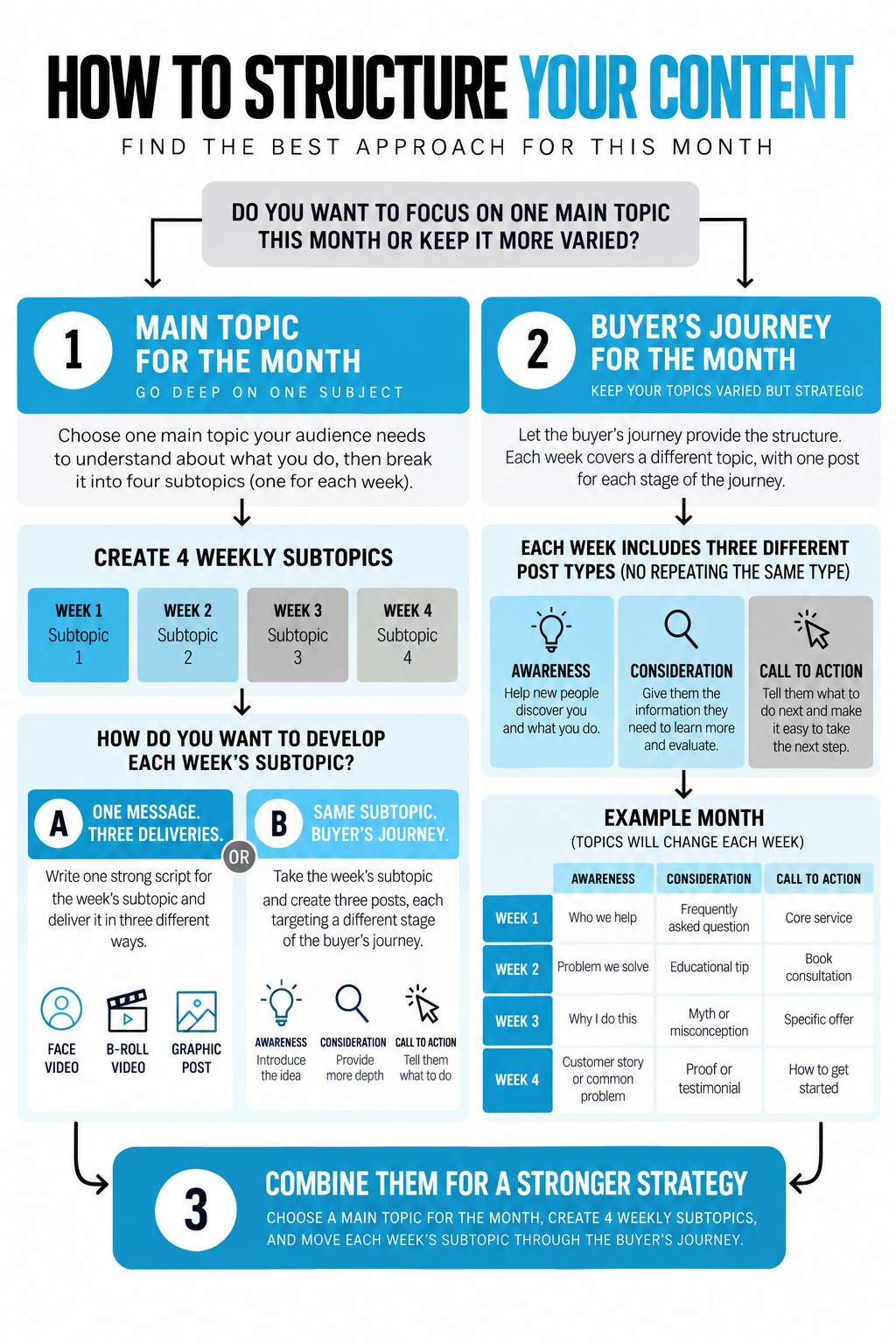
There are two very manageable ways to structure your month: choose one main topic and go deep, or let the buyer’s journey provide the structure. And once you get comfortable with both, you can combine them.
Option 1: Choose one main topic for the month.
This is your depth strategy. Choose one thing your audience really needs to understand about what you do, then break that topic into four subtopics—one for each week.
For Resolute Social, that could look like this:
Monthly topic: Getting Comfortable on Video
Week 1: Why being nervous isn't the problem
Week 2: What to say when you hit record
Week 3: How to make your video look better
Week 4: How to turn videos into strategic content
Now you aren't trying to invent 12 unrelated ideas. You're spending a month helping your audience understand one larger idea while approaching it from different directions.
You're also becoming associated with that subject. Instead of mentioning something once and moving on because you've convinced yourself everybody has already heard it, you're actually giving people enough exposure to understand what you know.
Option 2: Let the buyer's journey structure the month.
Maybe your business has too many things happening to spend an entire month on one subject. Fine. Let the buyer's journey organize the content instead.
For a three-post week, that gives you three different jobs:
Awareness → Interest/Consideration → Call to Action
The topic can change from post to post and week to week. What doesn't change is that you know why each post exists.
Here's an example cadence:
Week | Awareness | Consideration | Call to Action |
|---|---|---|---|
1 | Who we help | Frequently asked question | Core service |
2 | Problem we solve | Educational tip | Book consultation |
3 | Why I do this | Myth or misconception | Specific offer |
4 | Customer problem/story | Proof or testimonial | How to get started |
You're no longer choosing three random things to post because you need three things to post. You're deliberately moving people from discovering you to understanding you to knowing what to do next.
Delight can appear throughout the month where it makes sense: customer education after purchase, celebrating results, additional uses, follow-up help, referrals, complementary services, and reasons to come back for another cup.
☕ How do you turn one weekly subtopic into three posts?
If you choose the monthly-topic strategy, you've got another decision to make. Once you've chosen this week's subtopic, how are you going to develop it?
You have two good options.
One message. Three deliveries.
Write one strong core message or script for the week's subtopic, then deliver that idea three different ways.
It might become a face video, a B-roll video, and a graphic or carousel. Or instead of changing the format, you could change the way you enter the message: tell the story, teach the lesson, then give an example.
You're not coming up with three entirely new ideas. You're taking one useful idea and letting it earn its keep.
Repeating your message is not the same thing as repeating your content. Not everybody sees every post, remembers every post, or prefers to consume information in the same way.
Same subtopic. Three stages of the buyer's journey.
The other option is to take the week's subtopic and ask how you would talk about it to someone at three different points in the buyer's journey.
Let's use “What to say when you hit record.”
Awareness:
“You're not afraid of video. You're afraid you won't know what to say.”
Interest/Consideration:
“Here's the simple structure I use for a 30-second face video.”
Call to Action:
“If figuring out what to say is why you haven't made videos, I'll write the scripts and come record them with you.”
Same subject. Three completely different messages with three completely different jobs.
☕ Can you combine the monthly topic and the buyer's journey?
Absolutely. In fact, once you're comfortable with the basics, this is where the strategy gets really freaking useful.
Start with your main topic for the month. Break it into four weekly subtopics. Then move each week's subtopic through Awareness → Interest/Consideration → Call to Action.
The structure becomes:
MONTHLY TOPIC
↓
4 WEEKLY SUBTOPICS
↓
3 POSTS PER WEEK
↓
AWARENESS → CONSIDERATION → CALL TO ACTION
Now imagine looking at your calendar and knowing:
This is what I'm teaching this month. This is this week's piece of it. And this is where today's post fits in the customer's decision process.
That's a strategy.
Compare that to:
Crap. It's Wednesday. What am I supposed to post?
That's the difference we're trying to create.
☕ Which decisions should you make before choosing a format?
Here's where a lot of people start backward.
They decide, “I need to make a Reel.” Or a carousel. Or a graphic. Or somebody told them B-roll is performing well, so apparently they need some B-roll.
You don't know that yet.
The format is the container, not the strategy. Make the decisions from the top down:
Layer | Decision |
|---|---|
Month | What are we talking about? |
Week | What part of it are we talking about? |
Purpose | Awareness, Consideration, or CTA? |
Message | What specifically do I need to say? |
Delivery | Face video, B-roll, graphic, carousel, etc.? |
Idea first. Purpose next. Format later.
When you start with format, you're trying to figure out something to stuff into a Reel. When you start with strategy, you already know what you need to communicate. Then you choose the best way to communicate it.
☕ When are you finally ready to start creating the content?
Not until you've brewed the month.
Before you open Canva, prop up the phone, start writing captions, or wander into ChatGPT asking for 30 random social media posts, zoom out and look at the whole month.
Do the topics make sense together? Are you helping new people discover you? Are you giving interested people reasons to trust you? Are you actually asking people to buy? Does the content support what's happening in the business? And most importantly, can you explain why each post is there?
Once you can do that, you've got the recipe.
And then we're going to make the whole freaking pot.
Next week, we'll take the strategy you've mapped and start batching the thinking, writing, recording, creating, and editing so you're not making social media one freaking post at a time.
☕ HOOKS you can use to brew up a great content recipe
☕ Start With the Problem
If you keep dealing with [problem], this may be why.
You shouldn't have to [frustrating workaround] just to [desired result].
Before you assume [problem] is normal, consider this.
That little [symptom/problem] could be telling you something.
If [specific frustrating situation] keeps happening, pay attention.
Most people don't realize [problem] until [consequence].
The real reason you're struggling with [problem] may not be [assumption].
If you're tired of [specific frustration], start here.
[Problem] usually starts long before [bigger consequence].
Still dealing with [problem]? Here's what I'd look at first.
☕ Teach Something They Need to Know
Before you [buy/book/choose/do something], know this.
Here's what I wish more people understood about [topic].
There are [number] things I look for before recommending [solution].
Most people think [common belief]. That's not quite how it works.
Here's the difference between [option A] and [option B].
If you're considering [product/service], ask this question first.
One small change to [thing] can make a huge difference in [result].
You may not need [expected solution] at all.
Here's what actually matters when you're choosing [product/service/provider].
Before you spend money on [thing], check [specific consideration].
☕ Turn a Customer Question Into Content
One of the questions I get all the time is “[question]?”
Do you really need [product/service/action] if [situation]?
How do you know when it's time to [action]?
What happens if you don't [action]?
Is [common option] actually worth it?
What's the difference between [A] and [B]?
How long should [process/result] actually take?
Can you [desired result] without [thing they assume is required]?
What should you expect when you [book/buy/start]?
“What if [customer concern]?” Let's talk about that.
☕ Challenge What They Already Believe
You don't necessarily need [common solution] to get [result].
[Common advice] isn't always good advice.
Stop assuming [common belief about your industry].
More [thing] doesn't automatically mean better [result].
The cheapest [option] may be costing you more than you think.
[Popular tactic] isn't the problem. How you're using it might be.
Just because [common practice] is normal doesn't mean it works.
You may be solving the wrong problem.
Before you blame [obvious culprit], look at [overlooked issue].
I disagree with the advice to [common industry advice]. Here's why.
☕ Show How You Think
If you came to me with [problem], here's where I'd start.
When I see [situation], the first thing I look for is [thing].
I wouldn't recommend [solution] until I knew [information].
Here's why I usually recommend [A] instead of [B].
If this were my [home/business/body/project/etc.], I'd do this first.
There are times I will actually tell a customer NOT to buy [thing].
This is the part of [process] I refuse to rush.
One thing I won't compromise on when it comes to [topic] is [value].
After [number] years doing this, I've changed my mind about [topic].
Here's what experience has taught me about [problem].
☕ Give Them a Reason to Choose YOU
You have plenty of choices for [service]. Here's how I do it differently.
Before you hire me, you should probably know this about me.
I care way more about [value/result] than [industry vanity metric].
I got into this business because [specific reason].
If we work together, you can expect me to [specific behavior].
I will never tell a client to [thing you oppose].
This is the hill I'm willing to die on when it comes to [topic].
Here's what drives me freaking crazy about [industry practice].
My approach to [topic] is pretty simple: [belief].
If you believe [shared belief], we're probably going to work well together.
☕ Use Proof Without Making It a Boring Testimonial
A customer came to me with [problem]. Here's what we discovered.
This is what [desired result] actually looks like.
Before [solution], they were dealing with [specific situation].
We could have recommended [obvious solution]. We didn't.
This customer story perfectly explains why [lesson].
Here's what changed after we [specific action].
The biggest result wasn't [obvious result]. It was [more meaningful result].
This is why I keep telling people to [recommendation].
They thought the problem was [A]. It turned out to be [B].
Here's what happened when we changed just one thing.
☕ Ask for the Freaking Order
If you're ready to stop dealing with [problem], here's your next step.
Ready for [specific result]? Here's how we get started.
This is for you if you're [specific customer situation].
If [problem] is costing you [time/money/stress], let's fix it.
Here's exactly what happens when you book [service].
If you've been putting off [action], this is your sign to handle it.
Need help with [specific problem]? That's exactly what [offer] is for.
If you're thinking, “Yep, that's me,” here's what to do next.
You've done the research. Now let's get [result].
Ready to stop [problem] and start [desired outcome]? Here's how.